

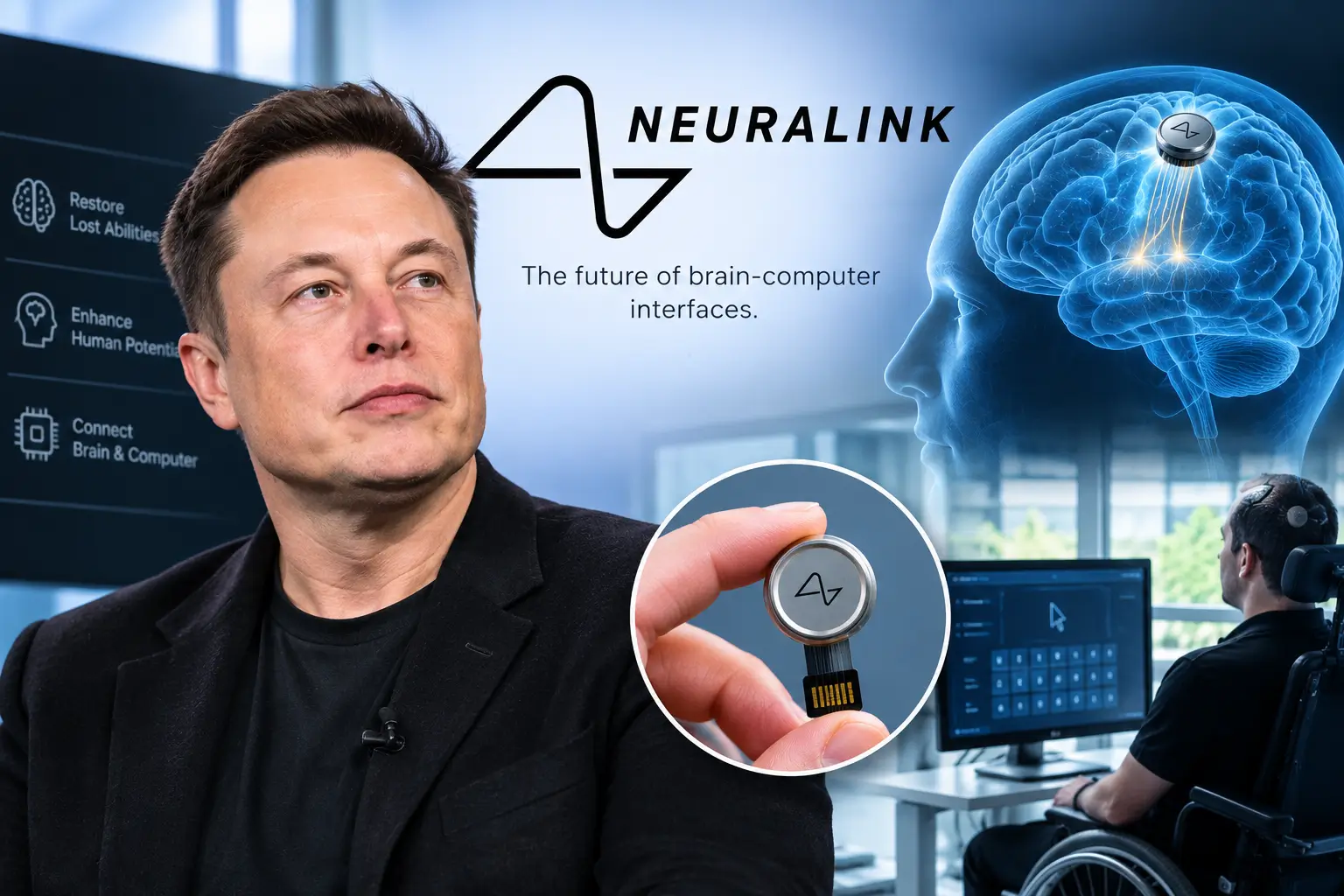
For people living with severe paralysis, the simplest digital tasks—moving a cursor, typing a message, or playing a game—can feel permanently out of reach. Elon Musk’s Neuralink is trying to change that. The company has developed a fully implantable brain-computer interface that records neural signals and turns them into digital commands. Early human participants are already using the system to control computers, robotic arms, and communication tools simply by thinking.
The work sits at the intersection of neuroscience, robotics, and engineering. It is still experimental, yet the progress since the first human implant in 2024 has been steady and carefully documented. What follows is a clear look at how the technology works, what participants are achieving, where the company is heading, and the practical questions that remain.
Profile Summary
| Aspect | Details |
|---|---|
| Founder | Elon Musk |
| Core Device | N1 / Link – fully implantable, coin-sized brain chip |
| Electrodes | 1,024+ channels via ultra-thin flexible threads |
| Primary Goal (Current) | Restore digital control for people with severe paralysis |
| Human Trials Started | 2024 (PRIME study) |
| Participants (Early 2026) | 21 enrolled worldwide |
| Key Achievements | Cursor control, typing (~40 wpm), robotic arm use, early speech decoding |
| Safety Record | Zero serious device-related adverse events reported |
| Surgical Method | Robotic implantation (increasingly automated, some transdural) |
| Next Targets | Speech restoration (VOICE), vision (Blindsight), higher electrode count |
| Production Plans | High-volume manufacturing targeted for 2026 |
| Availability | Clinical trials only – not yet commercially available |
The Core Technology Behind Neuralink’s Implant
Neuralink’s device, often called the Link or N1 implant, is a small, coin-sized package that sits flush beneath the skull. Ultra-thin, flexible polymer threads extend from it into the brain’s motor cortex. Each thread carries multiple electrodes—currently totaling more than a thousand recording sites—that detect the electrical spikes produced when neurons fire.
These signals are processed on the implant itself by custom low-power chips, then transmitted wirelessly to an external application. Software decodes patterns of neural activity into intended actions: cursor movement, clicks, or more complex commands. Because the threads are extremely fine, the surgical robot that places them can avoid blood vessels and minimize tissue disruption. The entire system is designed to be cosmetically invisible once the scalp heals, and the battery charges wirelessly.
The robot itself is a critical part of the platform. It inserts the threads with micron-level precision in a procedure that Neuralink continues to refine. Recent advances include techniques that place threads through the dura mater without fully opening it, further reducing invasiveness. The combination of high channel count, wireless operation, and robotic implantation distinguishes Neuralink from earlier research-grade brain interfaces that often required bulky external hardware or more disruptive surgery.
Human Trials and What Participants Are Achieving
Neuralink began its first human clinical study, known as PRIME, in 2024. By early 2026 the company reported 21 participants enrolled across sites in the United States, Canada, the United Kingdom, and the United Arab Emirates. The primary goal remains safety and the ability to control digital devices through thought alone.
Participants with cervical spinal cord injuries or ALS have demonstrated practical control. Several have reached cursor speeds comparable to able-bodied mouse users. Others have typed at rates approaching or exceeding 40 words per minute using neural signals. Videos released by the company and shared by participants show people browsing the web, posting on social media, playing games, and, in some cases, controlling robotic arms for basic self-care tasks such as feeding themselves. One Canadian participant with ALS was able to operate a smartphone and laptop shortly after surgery.
Importantly, Neuralink has reported zero serious device-related adverse events across these implants. Signal stability has improved with iterative hardware changes, including thinner threads and better retention designs. The company continues to expand enrollment while refining both the implant and the surgical process.
Expanding Beyond Cursor Control: Speech, Vision, and Broader Goals
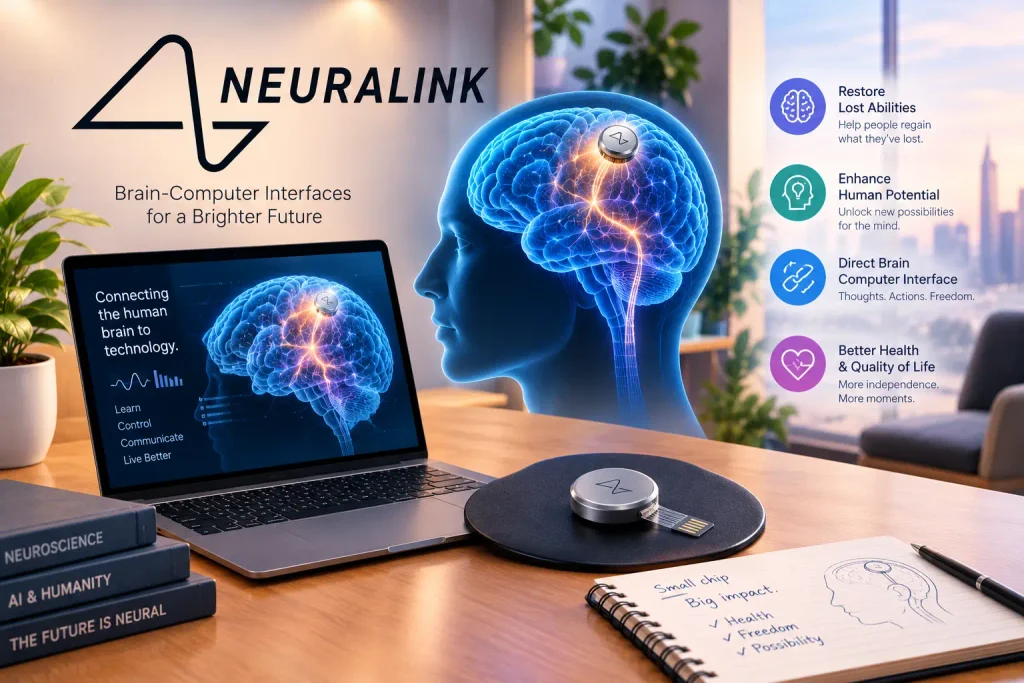
Motor control is only the starting point. Neuralink has launched additional studies aimed at restoring speech. The VOICE trial focuses on decoding intended speech from neural activity in language-related brain regions, with the ambitious target of conversational speeds. Early demonstrations have shown participants generating words and phrases through thought, though latency and accuracy remain areas of active improvement.
A separate program called Blindsight targets vision restoration. The concept involves stimulating the visual cortex so that even individuals who have lost their eyes or optic nerves might perceive visual information. Regulatory designations have been granted for related work, and first human trials are expected in the near term.
Looking further ahead, Neuralink’s stated long-term ambition is a generalized neural interface capable of addressing a wide range of brain-related conditions and, eventually, enabling higher-bandwidth communication between humans and artificial intelligence. Musk has repeatedly framed the work as both a medical necessity for those with severe disabilities and a longer-term path toward keeping human cognition relevant in an age of advanced AI.
The Surgical Robot and Path to Scale
Precision implantation at scale requires automation. Neuralink has invested heavily in its surgical robot, which can place hundreds of threads rapidly while avoiding critical structures. Recent procedures have demonstrated the ability to insert threads through the intact dura, simplifying one of the more delicate steps. The company has stated plans for high-volume device production and increasingly automated surgeries beginning in 2026.
These engineering efforts matter because clinical impact depends on consistency and accessibility. A system that works well for a handful of carefully selected participants must eventually perform reliably across different surgeons, hospitals, and patient anatomies. The robot and manufacturing scale-up are intended to address exactly those challenges.
Regulatory pathways remain rigorous. Neuralink works under FDA oversight in the United States and equivalent authorities elsewhere. Each expansion of enrollment or new indication requires additional data on safety and performance. The absence of serious device-related adverse events so far is encouraging, yet long-term durability, infection risk, and signal stability over years will continue to be scrutinized.
Challenges, Limitations, and Realistic Expectations
Brain-computer interfaces are still early. Current performance, while impressive for first-generation human implants, does not yet match the fluidity of natural movement or speech for every user. Some participants experience signal degradation over time that requires software recalibration or hardware iteration. The surgery, though refined, remains invasive and carries the inherent risks of any neurosurgical procedure.
Access is limited to clinical trial participants who meet strict criteria. Commercial availability, if achieved, will depend on further regulatory approvals, manufacturing capacity, and demonstrated benefit that outweighs the risks for broader populations. Ethical questions around data privacy, long-term brain health, and eventual enhancement applications also require ongoing attention from researchers, regulators, and society.
Despite these realities, the progress is concrete. People who previously had almost no independent digital access are using the system daily. That practical restoration of agency is the clearest measure of value at this stage.
Conclusion
Elon Musk’s Neuralink has moved brain-computer interfaces from laboratory demonstrations into sustained human use. The combination of a high-channel wireless implant, robotic surgical precision, and iterative clinical learning has produced measurable gains for participants with severe paralysis. Cursor control, typing, robotic arm use, and early speech decoding represent real functional steps forward.
The technology remains investigational. Scaling it safely, improving bandwidth and reliability, and expanding into vision and other domains will take years of careful work. Yet the direction is clear: Neuralink is building tools that aim to restore lost connections between mind and world. For the people already using the system, those tools are already changing what independence looks like.
Frequently Asked Questions
1. What is Neuralink?
Neuralink is a company founded by Elon Musk that develops implantable brain-computer interfaces designed to record neural activity and translate it into digital commands.
2. How does the Neuralink implant work?
A small device sits under the skull and connects to ultra-thin threads with electrodes that detect neuron firing in the brain. Signals are processed and sent wirelessly to an external app that turns them into actions such as moving a cursor.
3. How many people have received Neuralink implants?
As of early 2026, Neuralink reported 21 participants enrolled in its clinical trials worldwide.
4. What can participants currently do with the implant?
Many can control a computer cursor, type, browse the internet, play games, post on social media, and in some cases operate a robotic arm using only their thoughts.
5. Is the procedure safe?
Neuralink has reported zero serious device-related adverse events in its human trials so far. The surgery is still invasive and carries standard neurosurgical risks.
6. Can Neuralink restore speech or vision?
Speech restoration is being tested in the VOICE trial. A vision-focused program called Blindsight is in development, with human trials expected to begin soon.
7. Who is eligible for Neuralink trials?
Current trials primarily enroll adults with severe paralysis from spinal cord injury or ALS who meet specific medical criteria. Recruitment details are available through Neuralink’s official channels.
8. When will Neuralink be available outside of trials?
Commercial availability depends on further clinical data and regulatory approvals. High-volume production is planned for 2026, but broader patient access will take additional time.
9. Does the implant require wires outside the body?
No. The current Neuralink system is fully implantable and communicates wirelessly. The battery is charged inductively from outside the body.
10. What are Neuralink’s long-term goals?
Beyond restoring motor function, speech, and vision, the company aims to create a high-bandwidth interface that could eventually support broader treatment of neurological conditions and closer integration between human cognition and artificial intelligence.
You May Read Also:
Zenvekeypo4 Software: What It Is, What We Know, and How to Stay Safe
