

Introduction:
The phrase Dyson air conditioner can be slightly misleading. Dyson is famous for sleek bladeless fans and advanced air-treatment machines that can make a room feel considerably more comfortable, but Dyson’s cooling products are not conventional air conditioners. They move and circulate air to create a cooling effect rather than using a refrigeration system to lower the actual temperature of a room. Dyson itself explicitly distinguishes its fans and purifiers from air-conditioning units.
That distinction becomes particularly important when choosing a cooling appliance for a hot climate. A Dyson fan can produce a strong stream of air that feels refreshing against the skin, while a traditional split or portable AC removes heat from indoor air and lowers the room temperature. The two technologies solve related but fundamentally different problems. A Dyson can be an appealing alternative when personal comfort, air purification, quiet operation, design, and energy consumption matter more than dramatically lowering the room temperature.
Dyson’s current air-treatment range includes several products that combine cooling airflow with air purification, while some models also provide heating. The company uses its Air Multiplier technology to generate and project airflow without exposed fast-spinning blades. Some of its newer purifiers also use sophisticated filtration and sensors to monitor indoor pollutants.
So, is a Dyson cooling machine worth considering? The answer depends heavily on what you expect from it. If you want an appliance that makes you feel cooler while simultaneously filtering indoor air, Dyson offers compelling options. If your goal is to turn a 35°C room into a 22°C room, however, a Dyson fan is not a replacement for a genuine air conditioner.
Profile Summary
| Category | Details |
|---|---|
| Brand | Dyson |
| Product Type | Air-treatment and cooling appliances |
| Is It a Traditional AC? | No |
| Main Cooling Method | Powerful airflow directed toward the user |
| Key Technology | Dyson Air Multiplier |
| Bladeless Design | Yes, on Dyson’s fan-style cooling products |
| Air Purification | Available on Purifier Cool and Hot+Cool models |
| Heating Function | Available on Hot+Cool models |
| Temperature Reduction | Does not actively lower room temperature like a conventional AC |
| Cooling Benefit | Helps users feel cooler through continuous airflow |
| Oscillation | Available on many models |
| Sleep Mode | Available on selected models |
| Smart App Control | Available on selected models through the MyDyson app |
| Air Quality Sensors | Available on selected purifier models |
| HEPA Filtration | Available on selected purifier models |
| Carbon Filtration | Available on selected purifier models |
| Filter Replacement | Generally around 12 months, depending on usage and model |
| Best For | Personal cooling, airflow, purification, and year-round comfort |
| Not Ideal For | Dramatically lowering the temperature of an entire room |
| Main Advantage | Combines airflow with advanced air-treatment features |
| Main Disadvantage | Does not replace a conventional refrigeration-based AC |
| Ideal Rooms | Bedrooms, offices, studies, living rooms |
| Energy Use | Generally much lower than running a conventional AC for cooling airflow |
| Overall Position | Premium alternative or complement to traditional air conditioning |
What Is a Dyson Air Conditioner?
The first thing to understand about a so-called Dyson air conditioner is that Dyson does not market its current cooling fans as conventional air conditioners. Its own guidance says that its fans and purifiers are designed to help people feel cooler by supporting the body’s natural cooling mechanism, particularly through moving air across the skin. They do not operate like compressor-based AC systems that extract heat from a room.
This difference comes down to how heat is handled. A conventional air conditioner uses a refrigeration cycle to absorb heat from indoor air and release it elsewhere, normally outdoors. It can therefore reduce the temperature of the room. A fan does something much simpler: it moves air. When that moving air passes over your skin, it can accelerate evaporation of moisture and make your body feel cooler even though the room itself may remain at approximately the same temperature.
Dyson’s Air Multiplier technology is central to this experience. Rather than relying on conventional exposed blades, Dyson machines use a motor and carefully designed airflow channels to accelerate and amplify air through the machine. The result is a continuous stream of projected airflow without the familiar chopping sensation associated with traditional fan blades. Dyson describes its fan technology as producing powerful airflow for personal cooling.
That design has practical advantages. A bladeless structure gives the machine a distinctive appearance and makes visible surfaces easier to clean. It also eliminates exposed rapidly spinning blades, which can be useful in homes where safety and accessibility matter. Dyson’s newer Cool CF1, for example, is marketed as a bladeless cooling fan with a maximum airflow of 97 gallons per second and a Sleep mode designed for quieter nighttime operation.
The important takeaway is simple: a Dyson Air Conditioner can cool you without necessarily cooling the room. That may sound like a technical distinction, but it affects how satisfied you will be with the product. Someone sitting at a desk, sleeping in a bedroom, or relaxing on a sofa may find the airflow excellent. Someone trying to cool an entire apartment during an extreme heatwave may still need a true AC system.
Dyson Cooling Technology and How It Works
Air Multiplier technology is one of the defining features of Dyson’s cooling products. The system is designed to create a smooth stream of airflow rather than the intermittent sensation produced by traditional fan blades. Dyson says its technology amplifies airflow and creates powerful cooling without exposed blades.
Dyson Air Conditioner experience is especially noticeable when the machine is positioned close to a person. Instead of simply circulating air randomly around a room, the projected stream can be directed toward a chair, bed, workstation, or living area. Oscillation can also help distribute airflow more broadly, which makes the appliance useful when several people occupy the same room.
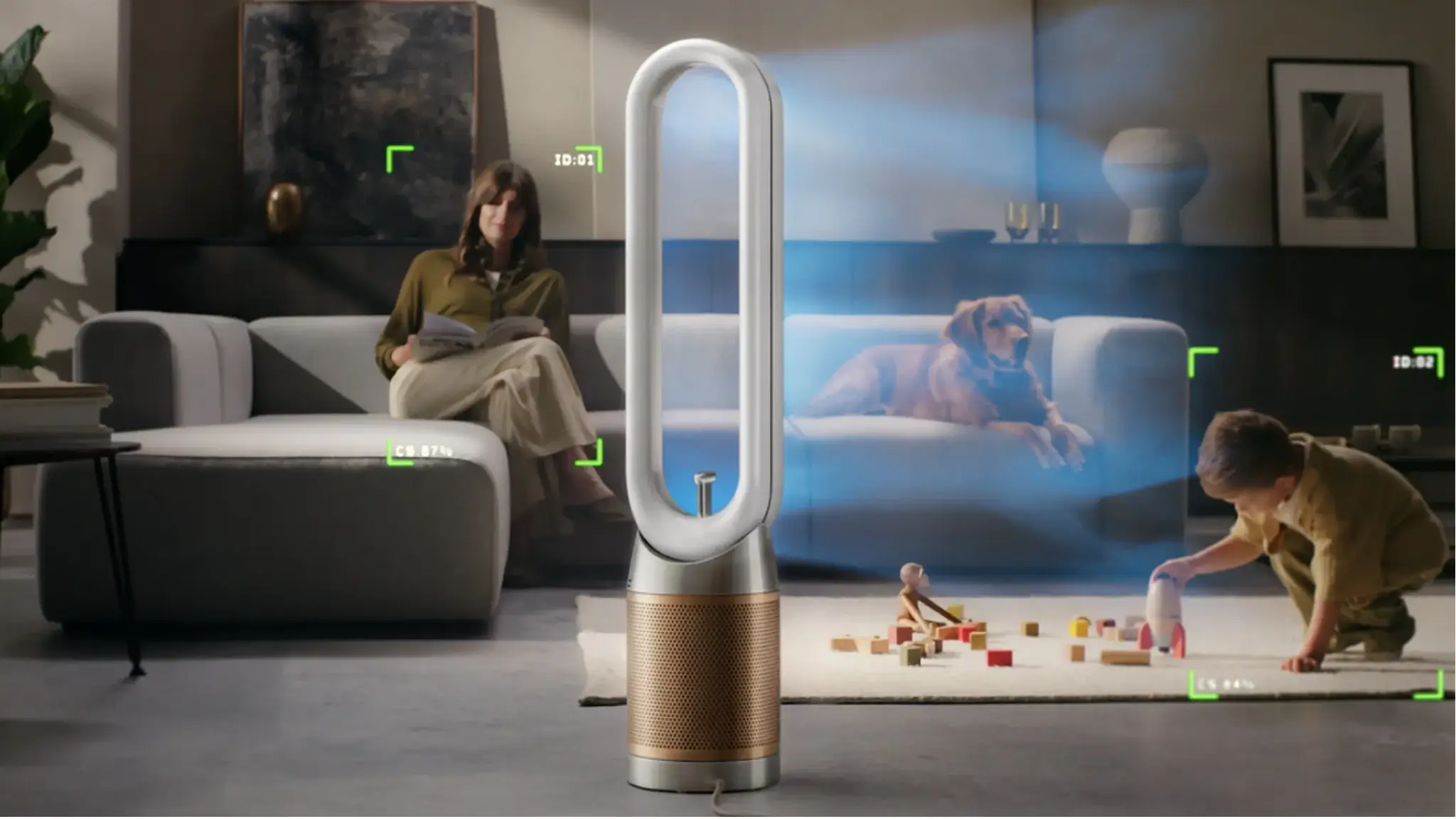
The newest Dyson machines add additional controls and intelligent features. The Dyson Purifier Cool PC3, for example, can detect a person and automatically direct cooling purified air toward them using its Find+Follow technology. Dyson says the system uses 17-point user detection and can adjust airflow distribution when more than one person is present.
Cooling Without Refrigeration
Dyson Air Conditioner cooling fan does not contain the compressor, condenser, evaporator, and refrigerant system found in a traditional AC. Consequently, it does not perform the heat-transfer process necessary to lower the room’s air temperature.
This can actually be an advantage in certain situations. If your main problem is that you feel uncomfortable while sitting at a desk, watching television, or sleeping, you may not need to cool every cubic meter of the room. Direct airflow can provide immediate personal comfort while consuming considerably less power than running a full-size air-conditioning system.
Dyson Air Conditioner itself notes that fans and air conditioners address different comfort needs. Fans move air to help people feel cooler, while air conditioning is specifically designed to lower room temperature. The better option depends on factors such as climate, room size, energy use, running costs, and the type of comfort a person wants.
That makes a Dyson particularly interesting as a complementary appliance. For example, a homeowner might use air conditioning to establish a comfortable room temperature and then use a fan at a lower setting to improve personal airflow. In some situations, this can allow the AC thermostat to be set slightly higher without sacrificing personal comfort.
Dyson Air Purifier and Cooling Features
One of Dyson’s strongest arguments is that some of its cooling machines do much more than move air. Products such as the Dyson Air Conditioner Purifier Cool and Dyson Purifier Hot+Cool combine airflow with filtration and environmental monitoring. This makes them fundamentally different from an ordinary pedestal fan.
The Dyson Purifier Cool TP07, for example, combines cooling airflow with HEPA and carbon filtration. Dyson states that its filter captures 99.95% of ultrafine particles down to 0.1 microns under its specified testing conditions, while its filtration claims also cover particles such as allergens and pollen. Dyson recommends replacing the HEPA+Carbon filter approximately every 12 months, depending on use.
The filtration function can be especially useful in rooms where dust, pollen, odors, or other airborne pollutants are a concern. Carbon filtration is aimed at gases and odors, while HEPA filtration is designed to capture fine particles. This does not transform the machine into an AC, but it adds another layer of functionality to the appliance.
Dyson Hot+Cool Models
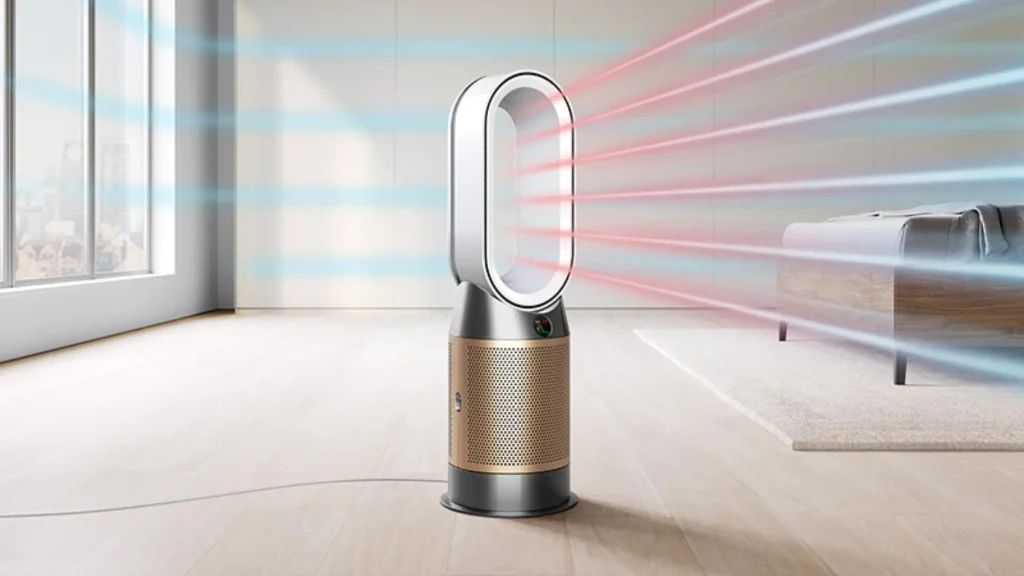
Dyson’s Hot+Cool machines take the concept further by adding heating. Current products include the dyson Air Conditioner Purifier Hot+Cool HP1 and the more advanced HP2 De-NOx. The machines are designed to provide heating during colder weather, cooling airflow during warmer conditions, and air purification throughout the year.
The HP2 De-NOx is particularly feature-rich. Dyson says it can capture 99.97% of particles as small as 0.3 microns, remove odors and gases, and capture more nitrogen dioxide than its predecessor. It also monitors environmental conditions and can be controlled through the MyDyson app.
This multi-function approach is appealing for people who dislike filling their home with separate appliances. One machine can provide heating in winter, airflow in summer, and purification throughout the year. That versatility can be more valuable than raw cooling performance for someone living in a moderate climate.
However, buyers should not confuse the phrase “cools you” with “air conditioner.” Dyson Air Conditioner uses that distinction throughout its product information. Its Hot+Cool machines provide cooling airflow but do not replace a refrigeration-based AC system.
Dyson Air Conditioner vs Traditional AC
The biggest difference between a Dyson cooling fan and an actual air conditioner is the effect on room temperature. A split AC can actively remove heat from indoor air. A Dyson fan cannot. It can make occupants feel cooler by moving air across their bodies, but the underlying room temperature does not fall simply because the fan is running.
This makes the choice largely dependent on climate and personal expectations. In a relatively mild room, a Dyson Air Conditioner can be extremely useful. Imagine someone working at a desk on a warm afternoon. Direct airflow toward the person’s body may provide enough comfort without the expense and noise associated with running an AC. The same principle can work in a bedroom at night when only moderate cooling is needed.
In extremely hot conditions, the situation changes. If indoor temperatures remain very high, airflow alone may not be enough. High humidity can also reduce the effectiveness of evaporative cooling from the skin, making a fan feel less effective. In those circumstances, actual temperature reduction and humidity management become much more valuable.
Energy use is another important distinction. Dyson’s current Cool CF1 fan is rated at a maximum of 30 watts, according to Dyson’s product information. A conventional AC typically requires substantially more electrical power because it is performing an active refrigeration cycle.
That does not automatically make a fan the better choice. If the room is dangerously hot, saving electricity is not the only consideration. Comfort and heat management come first. The sensible comparison is therefore not “Which machine is better?” but “Which machine performs the job I actually need?”
A Dyson Air Conditioner can be the better option for personal cooling, airflow, air purification, quiet operation, portability, and year-round versatility. A genuine air conditioner is the better choice when the objective is to reduce room temperature significantly.
Key Features to Look For in a Dyson Cooling Machine
A Dyson Air Conditioner cooling machine can include considerably more technology than a conventional fan, so buyers should focus on the features that genuinely matter in their homes rather than simply choosing the newest model.
Airflow and Oscillation
Strong airflow is the foundation of a cooling fan. Dyson’s machines are designed to project air over a distance, and models vary in airflow performance and projection. Oscillation is useful when cooling multiple people or distributing air throughout a larger room.
Purification
If indoor air quality is important, a purifier-fan combination can make more sense than buying a standalone fan. Dyson’s newer purifiers monitor airborne conditions and automatically adjust operation in response to detected pollutants. The HP1, for example, uses integrated sensors to analyze airborne pollutants and automatically react to changing conditions.
Sleep Mode
For bedrooms, Sleep mode can be more valuable than maximum airflow. Dyson’s newer Cool CF1 is designed to operate more quietly in Sleep mode, with a dimmed display and a lower-noise experience intended for nighttime use.
App Control
Selected dyson Air Conditioner models can connect to the MyDyson app. Depending on the model and market, users can control airflow, oscillation, sleep settings, schedules, and other functions. The HP2 De-NOx, for instance, supports remote control and seven-day scheduling through the app.
Filter Maintenance
Purifier models require ongoing filter maintenance. Dyson generally recommends replacing HEPA+Carbon filters around every 12 months, although actual filter life can vary according to usage and pollution levels. The machine can provide an alert when replacement is required.
These features can make a Dyson more expensive than a basic fan, but they also explain why many buyers consider Dyson products to be air-treatment systems rather than ordinary fans.
Pros and Cons of a Dyson Cooling Fan
A Dyson cooling machine has several obvious strengths. Its bladeless construction provides a distinctive modern appearance and makes visible surfaces easier to access for cleaning. The airflow is smooth, the controls can be sophisticated, and selected models combine cooling with purification and heating. This can reduce the number of separate appliances required in a home.
Another advantage is versatility. A Dyson Hot+Cool machine can remain useful throughout the year rather than being stored away after summer. Purification can continue even when heating or cooling is not needed, and app-connected models offer additional control. These characteristics make Dyson Air Conditioner especially attractive to people who value convenience and multifunctional design.
There are limitations, though. The most significant is the absence of true air conditioning. If your room is already extremely hot, a Dyson fan cannot perform the heat-removal job of a compressor-based AC. The machine may make you feel cooler while leaving the room itself just as warm.
Price can also be a consideration. Dyson’s advanced air-treatment products are premium appliances, and the cost can be considerably higher than a basic fan. If someone only needs simple airflow, spending substantially more may not make financial sense.
Filter replacement is another recurring expense for purifier models. Although filters may last around a year under typical recommendations, the actual interval depends on use and air conditions. Heavy use in a polluted environment may affect filter life.
The smartest approach is to identify the primary need first. If the requirement is simply “I want air moving across me,” a basic fan may be enough. If the requirement is “I want cooling airflow, filtration, heating, intelligent controls, and a premium design in one appliance,” a Dyson becomes much more compelling.
Is a Dyson Air Conditioner Worth It?
The answer depends on what you mean by “air conditioner.” If you mean a device that actively lowers the temperature of an entire room, then a Dyson cooling fan is not the right product. Dyson itself makes this distinction clear: its cooling fans provide airflow that helps cool people, but they are not air-conditioning units.
If you mean a premium cooling appliance that can make you feel significantly more comfortable while offering additional air-treatment features, the answer can be yes. Dyson’s purifier fans can combine cooling airflow with filtration, sensors, oscillation, and smart controls. Hot+Cool models add heating, making them particularly practical for households that want one year-round machine.
For a bedroom, office, study, or living room where targeted cooling is enough, a Dyson can be a sophisticated choice. Its airflow can be directed toward the person who needs it most rather than cooling an empty room. That distinction can be useful when only one or two people are occupying a space.
For very hot climates, however, it makes sense to think of Dyson as a complement to air conditioning rather than a complete substitute. An AC can handle the room temperature while the Dyson fan improves airflow and personal comfort. Dyson itself notes that fans and air conditioners can serve complementary purposes depending on the conditions.
Ultimately, Dyson’s biggest appeal is not that it secretly functions as an air conditioner. It doesn’t. Its appeal is that the company has taken the familiar concept of the fan and combined it with sophisticated airflow engineering, air purification, sensors, heating, and connected controls.
Conclusion
The Dyson air conditioner is best understood as a common search term for Dyson’s cooling fans and air-treatment machines rather than as a conventional AC product. Dyson’s current cooling range uses airflow to help people feel cooler, while its purifier models add filtration and environmental monitoring. Some Hot+Cool machines also provide whole-room heating, giving them genuine year-round usefulness.
The most important point is the difference between cooling a person and cooling a room. A Dyson fan can produce powerful airflow that feels refreshing, but it does not remove heat from a room in the way a traditional air conditioner does. That makes it excellent for personal comfort and airflow, but unsuitable as the sole cooling solution when indoor temperatures need to be substantially reduced.
For buyers who want a premium, quiet, attractive, multifunctional appliance, Dyson’s air-treatment range can be appealing. For anyone facing severe heat and expecting a dramatic drop in room temperature, a genuine air-conditioning system remains the appropriate technology.
Frequently Asked Questions
1. Is a Dyson air conditioner a real air conditioner?
No. Dyson’s cooling fans and purifier fans are not conventional air conditioners. They move and project air to help people feel cooler rather than using refrigeration to lower room temperature.
2. Does a Dyson fan lower room temperature?
A Dyson fan does not actively lower the room’s temperature like an AC. It creates airflow that can make your body feel cooler through increased air movement and evaporation.
3. Does Dyson make air purifiers that cool?
Yes. Dyson sells purifier-fan products such as the Purifier Cool range. These machines combine air purification with cooling airflow. Dyson explicitly describes the cooling function as fan-based rather than air conditioning.
4. What is Dyson Air Multiplier technology?
Air Multiplier technology is Dyson’s airflow system designed to generate and amplify a smooth stream of air without exposed conventional fan blades. It is used across several Dyson fan and air-treatment products.
5. Can a Dyson cool a bedroom?
Yes, a Dyson fan can provide effective personal cooling in a bedroom by directing airflow toward the bed or occupants. However, it will not reduce the bedroom temperature like a conventional AC.
6. Does Dyson have a heating and cooling machine?
Yes. Dyson’s Purifier Hot+Cool products provide heating and cooling airflow while also offering air purification. Current examples include the HP1 and HP2 De-NOx.
7. How often does a Dyson purifier filter need replacing?
Dyson generally recommends replacing its HEPA+Carbon filter approximately every 12 months, although actual filter life varies depending on usage and indoor pollution levels.
8. Are Dyson fans quiet?
Dyson designs several models with quieter operation and dedicated Sleep modes. The Cool CF1, for example, has a Sleep mode intended to reduce noise and dim the display for nighttime use.
9. Is a Dyson better than an air conditioner?
Neither is universally better because they perform different jobs. A Dyson can provide targeted airflow and, in some models, purification and heating. An AC is better when you need to reduce the actual temperature of a room.
10. Is a Dyson cooling fan worth buying?
It can be worth buying if you value powerful personal airflow, bladeless design, air purification, quiet operation, smart controls, or year-round heating and cooling functions. If your only goal is substantially lowering room temperature, a conventional air conditioner is the more appropriate choice.
You May Read Also:
