

Introduction:
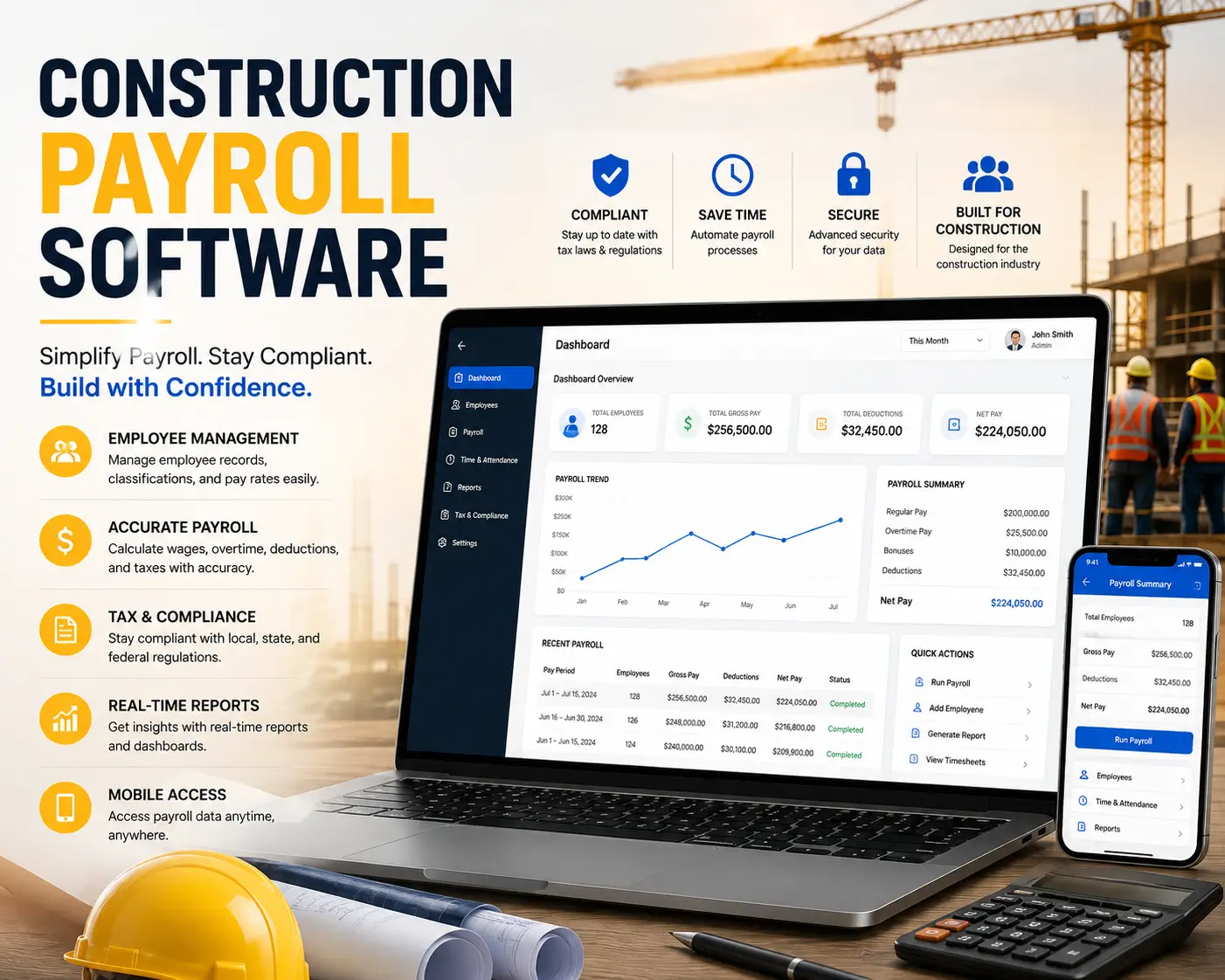
Construction payroll has never been as simple as calculating an hourly rate and issuing a paycheck. A construction company may have employees working across several projects, locations, and schedules, with different wage rates, overtime rules, allowances, deductions, classifications, and job responsibilities. Add changing work sites, subcontractor coordination, prevailing wage requirements, certified payroll, and constantly moving crews, and payroll quickly becomes one of the more demanding administrative responsibilities in the business. Construction payroll software is designed to bring those moving pieces together so contractors can process payroll with greater accuracy and less manual work.
The right system does more than replace a spreadsheet. It connects employee records, timecards, job costing, payroll calculations, tax information, and reporting in one organized environment. A project manager can capture hours from the field, an office administrator can review time and classifications, and a payroll professional can use approved information to calculate wages and deductions. When these processes are connected properly, construction companies can reduce duplicate data entry, identify errors earlier, understand labor costs more clearly, and create a more reliable payroll workflow.
Profile Summary
| Category | Details |
|---|---|
| Keyword | Construction Payroll Software |
| Primary Purpose | Managing payroll specifically for construction companies and contractors |
| Main Users | General contractors, subcontractors, builders, payroll teams, project managers, and construction business owners |
| Employee Time Tracking | Records employee hours, schedules, overtime, and job-site time |
| Job Costing | Allocates labor expenses to specific projects, phases, departments, or cost codes |
| Payroll Processing | Calculates wages, overtime, deductions, benefits, and other payroll components |
| Tax Management | Helps organize payroll tax calculations and related records |
| Certified Payroll | Can support detailed reporting for qualifying government and prevailing-wage projects |
| Prevailing Wage Support | Helps manage different wage rates and worker classifications when applicable |
| Mobile Access | Allows field employees and supervisors to submit or review time from job sites |
| Overtime Tracking | Helps identify and calculate additional hours according to configured rules |
| Labor Allocation | Connects employee hours with the appropriate construction projects |
| Accounting Integration | Can connect payroll information with accounting and financial workflows |
| Reporting | Provides payroll, labor-cost, employee, and project-related reports |
| Employee Records | Stores essential information such as pay rates, classifications, deductions, and payroll details |
| Automation | Reduces repetitive manual calculations and duplicate data entry |
| Error Reduction | Helps identify missing hours, unusual time entries, incorrect classifications, and other issues |
| Project Management Benefit | Gives managers better visibility into actual labor consumption |
| Employee Benefit | Makes time submission and access to payroll information more convenient |
| Security Requirement | Should provide appropriate access controls, authentication, backups, and protection for sensitive payroll data |
| Small Business Suitability | Useful for small contractors when the software is affordable and easy to operate |
| Large Business Suitability | Can support larger construction companies with multiple crews, projects, locations, and payroll requirements |
| Key Buying Factors | Features, usability, integrations, mobile capabilities, compliance support, security, scalability, and cost |
| Implementation Requirement | Accurate setup of employees, pay rates, classifications, deductions, job codes, and payroll rules |
| Training Requirement | Field workers, supervisors, payroll staff, and management may need role-specific training |
| Major Advantage | Connects payroll data with labor and project-cost information |
| Potential Challenge | Poor configuration or inadequate training can reduce the benefits of the system |
| Best Overall Approach | Choose software based on the company’s actual payroll, workforce, and project-management requirements |
What Is Construction Payroll Software and Why Does It Matter?
Construction payroll software is a specialized payroll management system built around the needs of contractors, builders, general construction companies, and other organizations whose employees work on projects or job sites. Traditional payroll applications can calculate wages and deductions, but construction businesses often require additional capabilities because labor costs need to be connected to specific jobs, cost codes, locations, and classifications. A good construction-focused platform is built to handle that additional layer of complexity.
Consider a construction company with five active projects and 60 field employees. A worker may spend Monday and Tuesday on one project, Wednesday on another, and Thursday and Friday at a third location. Those hours may need to be assigned to separate jobs or cost codes before payroll is processed. If employees record everything on paper or through disconnected spreadsheets, someone in the office has to manually transfer and organize the information. A construction payroll system can connect time tracking and payroll so those hours flow into the appropriate records with fewer opportunities for transcription mistakes.
Payroll Is Closely Connected to Job Costs
One of the biggest advantages of construction-specific payroll software is the relationship between payroll and job costing. Labor is often one of the largest expenses on a construction project, so knowing how much labor is being spent on a particular job is essential for financial management. Payroll information can help contractors compare actual labor costs with estimates, identify projects that are consuming more hours than expected, and make better decisions about staffing.
This visibility can be especially valuable when a company is managing several projects simultaneously. Instead of looking only at the total payroll expense, management can examine labor by project, employee, department, phase, or cost category. That gives the business a much clearer understanding of where money is going and whether labor assumptions used during bidding and planning are holding up in the field.
Key Features to Look for in Construction Payroll Software
Not every payroll system is equally suited to construction. A basic application may handle employee wages and tax calculations adequately while offering very little support for job-site realities. Contractors should therefore evaluate software based on how well it handles the entire payroll process rather than judging it solely by its ability to produce paychecks.
Time and Attendance Tracking
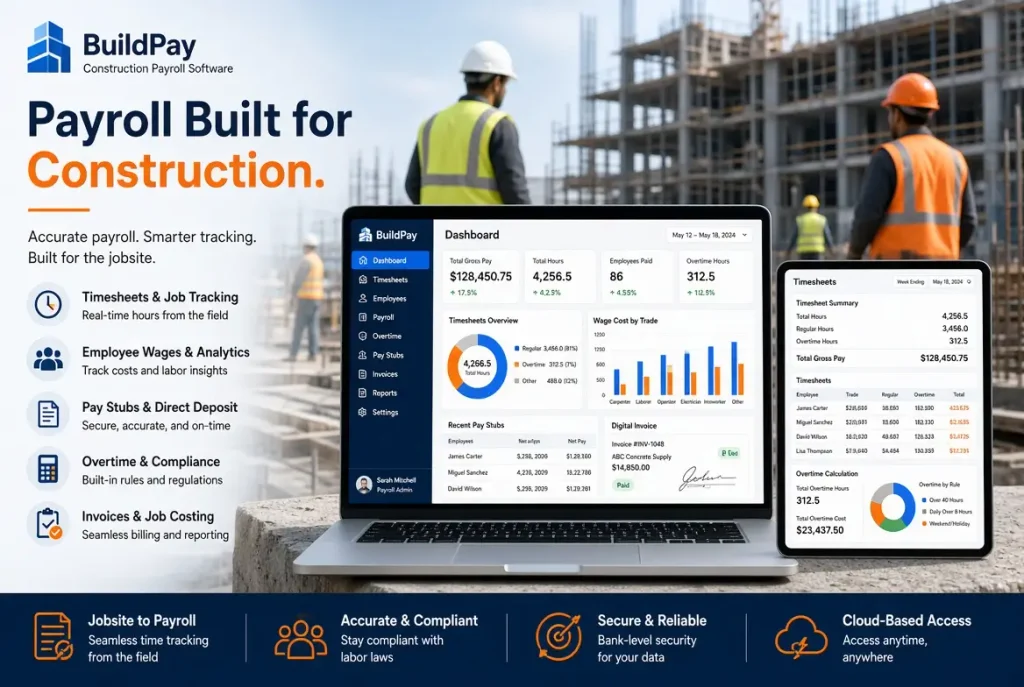
Accurate time tracking is at the heart of construction payroll. Employees need a convenient way to record when they start and finish work, while managers need tools to review, correct, and approve those records. Mobile time tracking can be particularly useful for field crews because employees do not have to return to an office simply to submit hours.
Some systems can associate time with specific jobs, phases, or cost codes. That makes the information useful for both payroll and project management. For example, if a carpenter records eight hours against a particular project, those hours can contribute to the employee’s paycheck while also becoming part of the project’s labor-cost record.
A strong system should also make it easy to handle overtime and unusual schedules. Construction crews may work longer days when deadlines approach, and payroll administrators need to know that additional hours are being calculated according to the applicable rules.
Job Costing and Labor Allocation
Job costing is another major feature to consider. The software should make it possible to assign employee hours to the correct project without creating an unnecessarily complicated process for workers or supervisors.
Suppose an electrician spends four hours troubleshooting an installation problem on Project A and another four hours completing planned work on Project B. A system that captures those hours separately provides much more useful information than a generic eight-hour timecard. Management can see the actual labor consumed by each project and use that information when evaluating profitability.
Payroll Tax and Deduction Management
Payroll involves more than gross wages. Taxes, benefits, retirement contributions, garnishments, deductions, reimbursements, and other adjustments may all need to be calculated and documented. Good payroll software automates much of this process while maintaining employee records that can be reviewed when questions arise.
Automation does not eliminate the need for responsible payroll oversight. Tax rules and employment requirements can change, and construction companies may operate across multiple jurisdictions. Businesses should confirm that the software supports the locations and payroll requirements relevant to their operations and that updates are provided when regulations change.
Certified Payroll and Compliance Support
Some construction projects require detailed wage reporting. Government-funded work, prevailing-wage projects, union environments, and particular contracts may require additional documentation. Software with certified payroll capabilities can reduce the administrative burden involved in producing these reports.
The value of this feature becomes clear when a company is managing a large project with numerous workers and classifications. Instead of gathering information from scattered records at the end of the reporting period, the business can maintain the relevant information throughout the payroll process. That creates a more organized audit trail and reduces the pressure of reconstructing records later.
How Construction Payroll Software Improves Accuracy and Efficiency
Manual payroll processes can create small errors that become expensive problems. An employee may forget to record an hour, a supervisor may approve the wrong project code, or an administrator may accidentally enter the same information twice. Individually, these mistakes may seem minor. Across dozens or hundreds of employees and multiple pay periods, however, they can affect labor costs, employee satisfaction, financial reports, and compliance.
Construction payroll software helps by creating a consistent workflow. Employees submit time, supervisors review it, payroll staff verify exceptions, and the approved information moves into payroll. When the system is configured correctly, fewer steps depend on someone manually copying information between unrelated files.
Reducing Duplicate Data Entry
Imagine an office employee receiving paper timecards from several job sites every Friday. They must read each card, enter the hours into a spreadsheet, calculate overtime, determine job allocations, and then transfer the information into payroll software. Every manual transfer introduces another opportunity for error.
An integrated system can remove many of those repetitive steps. Hours entered by employees can move through an approval process before being used for payroll. The same underlying information can also support job costing and labor reporting. That means the company gets more value from each piece of data instead of repeatedly recreating it.
Faster Payroll Review
Automation can also make payroll review more efficient. Rather than examining every timecard from scratch, administrators can focus attention on exceptions. For example, the system might flag unusually high hours, missing time, duplicate entries, incorrect job codes, or other information that requires review.
This changes the role of the payroll administrator. Instead of spending most of the day typing information, the administrator can spend more time checking whether the information makes sense. That is a much better use of skilled administrative time and can help catch problems before employees are paid.
Better Employee Experience
Payroll accuracy directly affects employee trust. Construction workers expect their hours, overtime, allowances, and deductions to be recorded correctly. When employees repeatedly have to contact the office about missing hours or incorrect pay, frustration builds quickly.
A well-designed payroll system can give employees greater visibility into their time records and payroll information. Depending on the software, workers may be able to review submitted hours, access pay information, update certain personal details, or receive payroll documents electronically. Those conveniences can make payroll feel less mysterious and reduce unnecessary back-and-forth with the office.
Choosing the Right Construction Payroll Software for Your Business
The best payroll system for a small residential contractor may not be the best choice for a large commercial builder. Company size, geographic coverage, workforce structure, accounting practices, and project requirements all influence what a business actually needs.
A contractor with 15 employees may prioritize affordability, simplicity, mobile time tracking, and basic job costing. A larger construction organization may require sophisticated labor allocation, certified payroll, union support, multi-state payroll, detailed reporting, accounting integration, and extensive user permissions. Buying software with dozens of features does not automatically make it the better choice if employees struggle to use those features.
Start With the Payroll Process, Not the Software
Before comparing products, map out how payroll currently works. Identify where employee hours originate, who approves them, how overtime is handled, how job codes are assigned, who prepares payroll, and where errors typically occur.
This exercise often reveals the most important software requirements. If the biggest problem is inaccurate field time, mobile time tracking may deserve greater attention than advanced reporting. If the company struggles with project profitability, job costing and accounting integration may be more important. If government contracts create a heavy reporting burden, certified payroll functionality may be essential.
Consider Integration With Accounting
Payroll should not exist as an isolated system. Construction companies frequently need payroll information to connect with accounting, project management, human resources, and timekeeping systems. Strong integration can reduce the amount of information that employees have to enter manually.
For example, payroll data may need to flow into the general ledger while labor information feeds project-cost reports. If the payroll platform cannot communicate with the systems the company already uses, employees may end up exporting spreadsheets and manually reconciling information. Before purchasing software, contractors should determine exactly which integrations are available and whether they support the company’s existing workflow.
Evaluate Mobile and Field Capabilities
A construction payroll system should work where construction work actually happens. Field employees may be using smartphones or tablets rather than desktop computers, and the software should be practical for that environment.
Ease of use matters more than an impressive feature list. If workers need several minutes and complicated menus just to enter their hours, adoption may suffer. A good field experience should make routine tasks quick while giving supervisors sufficient control to review and approve information.
Common Mistakes Companies Make When Implementing Payroll Software
Purchasing payroll software is only the beginning. Implementation determines whether the system becomes a useful part of the business or another administrative burden. One common mistake is attempting to reproduce every existing manual process inside the new platform without questioning whether those processes make sense.
A better approach is to examine the current workflow and simplify it where possible. If three spreadsheets are currently used to track hours, job codes, and payroll adjustments, the company should ask why those spreadsheets exist and whether the software can replace them with one controlled process. The goal should not simply be to digitize old habits. It should be to create a cleaner way of working.
Poor Employee Training
Construction payroll software affects field workers, supervisors, office staff, accountants, and management. Each group interacts with the system differently. Employees may only need to enter hours, while payroll administrators may manage deductions, reports, and compliance information.
Training should therefore be practical and role-specific. Workers should understand how and when to submit time. Supervisors should know how to review and correct records. Payroll staff should understand exception handling and reporting. Management should know how to interpret labor-cost information. A short demonstration at launch is rarely enough for a complex organization.
Incorrect Initial Setup
Payroll systems depend heavily on accurate configuration. Employee classifications, pay rates, overtime rules, job codes, deductions, benefits, tax information, and accounting categories must be set up correctly.
Companies should take time to test the system before relying on it for a live payroll. Running sample payrolls can expose incorrect calculations or missing information before those issues affect actual employees. It is far easier to correct a configuration problem during testing than after payroll has already been processed.
Ignoring Data Security
Payroll data contains sensitive employee information, so security should be treated as a fundamental requirement. Businesses should examine access controls, authentication options, backup practices, audit trails, data protection, and the vendor’s approach to handling employee information.
Not every person in the organization needs access to every payroll record. Role-based permissions can help ensure that employees, supervisors, payroll administrators, and executives see only the information appropriate to their responsibilities.
The Future of Construction Payroll Software
Construction payroll systems are becoming increasingly connected to broader workforce and project-management technology. Time tracking, payroll, job costing, workforce management, accounting, and reporting are gradually becoming parts of the same digital workflow. The practical benefit is not simply having more software. It is reducing the distance between what happens on a job site and what management sees in the office.
Artificial intelligence and automation may also play a larger role in identifying unusual payroll patterns, predicting labor requirements, organizing records, and highlighting potential errors. For example, a system could potentially identify an unusual concentration of overtime or flag a labor allocation that differs significantly from historical project patterns. Such tools should support human judgment rather than replace it, particularly when payroll and compliance decisions have financial consequences.
Greater Emphasis on Real-Time Information
Construction managers increasingly need current information rather than reports that become available days after work has been completed. If labor hours are captured promptly, management can gain a more current picture of project performance.
That information can influence staffing decisions, scheduling, overtime management, and project planning. A project that appears profitable based on an old estimate may look very different once actual labor consumption is updated. Timely payroll and timekeeping information can therefore become a management tool rather than simply an administrative record.
More Connected Workflows
The long-term direction is toward connected systems in which an employee’s work information follows a logical path from the field to payroll and project accounting. A worker records time, a supervisor approves it, payroll calculates compensation, and the associated labor expense contributes to project reporting.
When these systems communicate effectively, companies gain a clearer view of both people and projects. The real advantage is not automation for its own sake. It is having reliable information available when someone needs to make a decision.
Conclusion
Construction payroll software can transform payroll from a fragmented administrative process into a connected part of construction management. By combining time tracking, job costing, payroll calculations, reporting, compliance support, and employee information, the right system can reduce repetitive work while giving contractors better control over labor costs.
The most effective solution is not necessarily the platform with the longest feature list. It is the one that fits the company’s actual workflow, works well for field employees, supports accurate payroll, connects with existing accounting systems, and provides the reports managers genuinely need. Contractors should evaluate their current process first, identify the areas causing the most difficulty, and then choose software that solves those specific problems.
When implemented carefully, construction payroll software becomes more than a way to process paychecks. It becomes a reliable source of workforce and labor-cost information that can help a construction business operate with greater accuracy, accountability, and confidence.
Frequently Asked Questions
1. What is construction payroll software?
Construction payroll software is a payroll management solution designed specifically for contractors and construction companies. It typically combines payroll processing with construction-specific features such as job costing, time tracking, labor allocation, employee classifications, and compliance reporting.
2. How is construction payroll software different from regular payroll software?
Regular payroll software primarily focuses on employee compensation, taxes, deductions, and payroll records. Construction payroll software generally adds features for project-based work, including job codes, cost codes, field time tracking, labor allocation, prevailing-wage requirements, and certified payroll reporting.
3. Can construction payroll software track employee hours?
Yes. Time and attendance tracking is one of the most common features. Depending on the system, employees may record hours through mobile devices, tablets, time clocks, or other methods, with those hours then routed through an approval process.
4. Can payroll software help with construction job costing?
Yes. Many construction-focused systems allow employee hours and labor expenses to be assigned to specific projects, phases, or cost codes. This can help contractors compare actual labor spending with project budgets and estimates.
5. Does construction payroll software handle overtime?
Many systems can calculate overtime based on configured payroll rules. However, businesses should verify that the software supports the specific overtime requirements applicable to their employees and locations.
6. What is certified payroll?
Certified payroll is a detailed payroll report required for certain construction projects, particularly some public works contracts. It generally provides information about workers, classifications, wages, hours, and related payroll details. Software with certified payroll capabilities can simplify the preparation of these reports.
7. Is construction payroll software suitable for small contractors?
Yes. Small contractors can benefit from automated payroll, mobile time tracking, electronic records, and basic job-cost visibility. The key is choosing a system whose features and pricing match the company’s size rather than paying for unnecessary complexity.
8. Can construction payroll software integrate with accounting systems?
Many construction payroll platforms provide accounting integrations. These connections can allow payroll and labor-cost information to move between payroll and accounting workflows, reducing duplicate data entry and manual reconciliation.
9. What should I consider before buying construction payroll software?
Consider employee count, number of job sites, geographic locations, overtime requirements, job costing needs, certified payroll requirements, accounting integrations, mobile capabilities, reporting, security, ease of use, customer support, and total cost.
10. What is the biggest benefit of construction payroll software?
The biggest benefit is the ability to connect accurate employee time and payroll information with construction operations. Instead of treating payroll as an isolated administrative task, companies can use the same information to understand labor costs, manage projects, reduce errors, and make better workforce decisions.
You May Read Also:
Stewart from WaveTechGlobal: Who Is Dorian Stewart and What Is His Role?

1 Comment
Pingback: Outlier AI: Jobs, Pay, Requirements & How It Works