

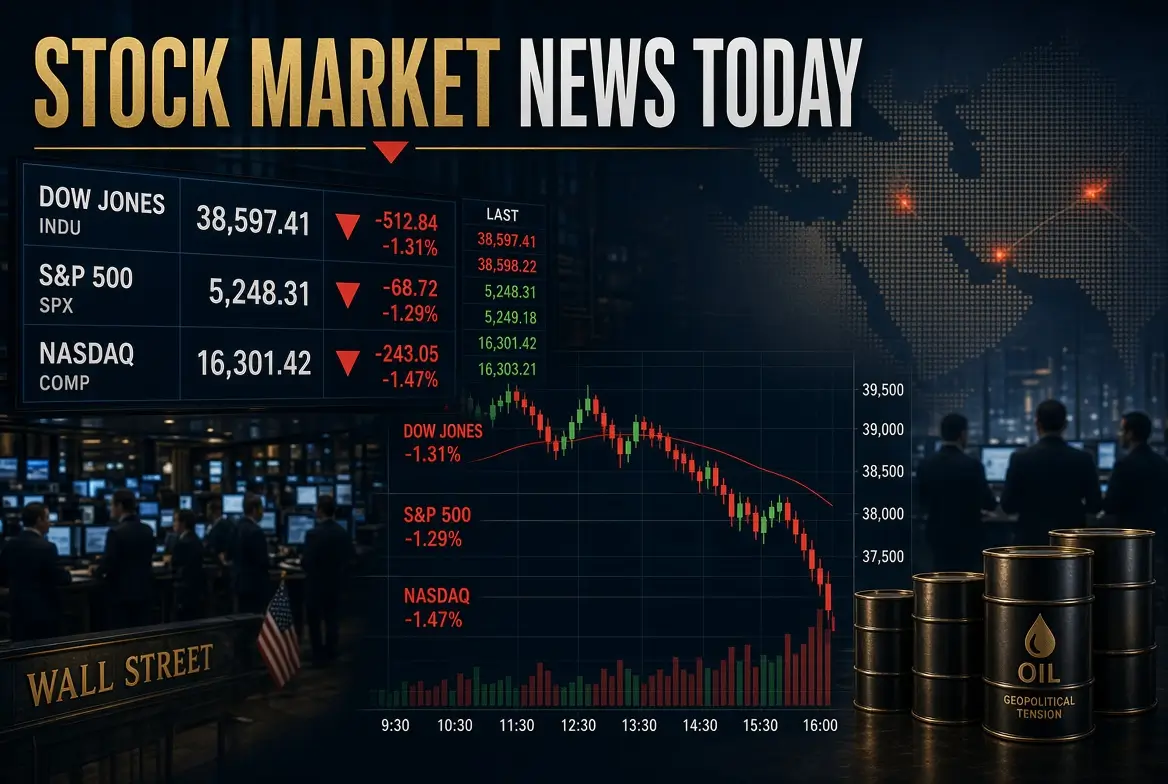
Wall Street returned from the Labor Day weekend with little enthusiasm. The major indexes finished Tuesday lower, led by a sharp decline in the Dow Jones Industrial Average, as investors weighed a fresh rise in oil prices against ongoing conflict in the Middle East and shifting expectations for Federal Reserve policy. The session set a cautious tone for the rest of the week, with inflation data and the next Fed meeting already circling on calendars.
The day’s action reflected a market still trying to balance strong year-to-date gains against new sources of uncertainty. Energy costs, bond yields, and geopolitical headlines all pulled in the same direction, creating the kind of environment where even solid corporate news struggled to offset broader selling pressure.
Profile Summary
| Category | Details |
|---|---|
| Dow Jones | Closed at 52,786.07 (−628 points / −1.18%) |
| S&P 500 | Closed at 7,673.52 (−45 points / −0.58%) |
| Nasdaq Composite | Closed at 26,421.41 (−86 points / −0.32%) |
| Russell 2000 | Closed lower (−0.5%) |
| Main Drivers | Surging oil prices, Middle East tensions, higher Treasury yields, rising Fed rate-hike odds |
| Brent Crude | Approached $99, settled near $97 |
| 10-Year Treasury Yield | Briefly above 4.8% |
| Best Sector | Energy (+1.0%) |
| Worst Sector | Healthcare (−2.55%) |
| Notable Gainers | Intel (+≈9%), Corning (strong gain on Verizon deal), energy names |
| Notable Losers | Amgen (−≈10%), Novartis (−≈14%), Salesforce, ServiceNow |
| Fed Rate-Hike Odds | ≈60% chance of 25 bp hike at mid-September meeting |
| Year-to-Date Performance | S&P 500 +12.1%, Nasdaq +13.7%, Dow +9.8% |
Major Indexes Close Lower After the Holiday Weekend
The Dow Jones Industrial Average absorbed the heaviest damage, falling 628 points, or 1.18 percent, to close at 52,786. That marked one of its steeper single-day declines in recent weeks and left the blue-chip index further from the highs it reached earlier in the summer. The S&P 500 slipped 0.58 percent to 7,673.52, while the Nasdaq Composite eased 0.32 percent to 26,421.41. Smaller companies tracked the broader weakness, with the Russell 2000 also finishing lower. stock market news today.
These moves came after markets had been closed for the extended weekend, giving investors time to absorb weekend developments in the Middle East. By the open, futures were already pointing lower, and the early selling never fully reversed. Volume remained orderly rather than panicked, yet the direction was clear: risk appetite had cooled. Health-care names and certain software stocks added to the pressure on the major averages, while energy provided one of the few bright spots.
The broader context still shows resilience. The S&P 500 remains up more than 12 percent for the year, and the Nasdaq has gained roughly 14 percent. Yet the recent stretch has grown choppier. The index has now declined in five of the past seven sessions, and the distance from the mid-August record high has widened. That shift has left many participants more focused on near-term catalysts than on the longer-term uptrend that defined much of 2026.
Oil Prices and Middle East Tensions Drive Investor Caution
Crude oil provided the day’s most visible pressure point. Brent futures climbed toward the $99 level at one stage, the highest since late July, before settling near $97.Stock market news today west Texas Intermediate also advanced, adding to concerns that higher energy costs could feed into broader inflation readings. The move followed reports of further hostilities involving Iran-backed forces and attacks on energy infrastructure in Saudi Arabia, which disrupted operations at certain facilities.
These developments revived an inflation premium that markets had largely set aside during quieter periods. The 10-year Treasury yield briefly pushed above 4.8 percent, a level not seen in nearly three years, before easing slightly. Higher yields raise the discount rate applied to future corporate earnings and increase borrowing costs across the economy. With the Federal Reserve scheduled to meet next week, traders raised the probability of a 25-basis-point rate increase to around 60 percent, according to market pricing tools.
The combination of rising oil and firmer yields created a classic risk-off backdrop. Energy producers benefited, but the rest of the market treated the higher input costs as a headwind for consumers and companies alike. Comments from political figures suggesting that oil prices would eventually fall once certain geopolitical outcomes materialize did little to calm trading desks in the moment. Markets price the present, not the hoped-for future, and the present still carried elevated energy risk. stock market news today.

Sector Performance Reveals Clear Winners and Losers
Energy stood out as the strongest sector, finishing higher as crude prices advanced. Utilities also managed modest gains, offering the defensive characteristics investors often seek when uncertainty rises. Stock market news today those two groups provided the main counterweight to broader selling.
Healthcare absorbed the largest decline. Amgen shares dropped roughly 10 percent after Novartis reported a Phase 3 trial setback for its cardiovascular candidate pelacarsen. Because Amgen is developing a related therapy, investors applied a read-across penalty that pulled the entire group lower. Financials also lagged, pressured by the rise in yields and the prospect of tighter policy. Stock market news today.
Software and certain technology names faced their own challenges. Speculation around the competitive impact of new artificial-intelligence models weighed on specialized software providers. Salesforce, ServiceNow, and similar names registered notable declines. In contrast, some semiconductor and infrastructure names held up better or even advanced, reflecting ongoing demand for the physical hardware that underpins AI development.Stock market news today the split within technology illustrated how the market continues to differentiate between pure software exposure and the companies supplying the underlying compute and networking capacity.
Individual Stock Movers That Shaped the Session
Several large-capitalization names drove the index-level moves. Amgen’s sharp drop was the single largest drag on the Dow. Intel, by contrast, jumped approximately 9 percent after reports that the company planned price increases and after positive developments tied to custom AI chip work with a major cloud provider. Corning also advanced strongly following a sizable multiyear supply agreement for optical fiber with Verizon, highlighting continued investment in network infrastructure Stock Market News Today.
On the downside, software names such as Salesforce and ServiceNow registered multi-percentage-point losses. Smaller biotech and specialty names produced even larger percentage swings in both directions, but their limited weight kept them from dominating the major averages. The pattern was familiar: company-specific news still mattered, yet the broader macro and geopolitical backdrop determined the overall direction of flow. Stock market news today.
These individual moves underscored a market that remains selective. Investors rewarded tangible progress on pricing power, supply contracts, and AI-related hardware while penalizing clinical setbacks and any suggestion that new technology could disrupt established software franchises. Stock market news today that selectivity has been a consistent feature of 2026 trading and shows little sign of disappearing.
What Investors Should Watch in the Coming Sessions
The rest of the week carries several scheduled catalysts. Producer price and consumer price data will arrive before the Federal Reserve’s mid-September meeting, giving policymakers and markets a final look at inflation trends. Any upside surprise in those reports would likely reinforce the case for a rate increase and could extend pressure on equities. Conversely, softer readings might ease the recent rise in yields and support a rebound. Stock market news today.
Geopolitical developments remain a wild card. Further escalation involving energy infrastructure or shipping lanes could keep oil elevated and maintain the inflation premium currently priced into bonds. Trade measures between the United States and Canada also entered a new phase, adding another layer of policy uncertainty for certain sectors.
Corporate earnings continue in the background. A handful of companies reported results or guidance that moved their shares meaningfully, and more updates are scheduled. In this environment, clear beats or constructive outlooks can still produce outsized gains even when the indexes are soft. Stock market news today the opposite is equally true for disappointments.
Positioning heading into the Fed decision will matter. Markets have already adjusted rate expectations higher; the question is whether those expectations prove accurate and how equities respond once the decision is known. Historical patterns suggest September can be a volatile month, and the current mix of oil, yields, and geopolitics has given that seasonal tendency fresh fuel.
Stock market news today the session on September 8 illustrated how quickly sentiment can shift when energy prices and policy odds move together. Major indexes finished lower, leadership concentrated in energy and select hardware names, and healthcare plus software absorbed the bulk of the damage. Yet the longer-term backdrop still shows solid year-to-date gains and an economy that has so far absorbed earlier shocks.
Investors who treat the current environment as one of heightened but manageable uncertainty, rather than outright crisis, are likely to navigate the next stretch more effectively. Watching the incoming inflation data, the path of oil, and the Fed’s communication will provide the clearest signals in the days ahead. The market has already begun adjusting; the question now is how far that adjustment needs to run.
Conclusion
Stock market news today session on September 8, 2026, delivered a clear message: after a strong run earlier in the year, investors are once again pricing in higher energy costs, geopolitical friction, and the possibility of tighter monetary policy. The Dow’s sharp drop, the softer tone in the S&P 500 and Nasdaq, and the rotation toward energy stocks all reflected that shift in mood.
Yet the bigger picture remains constructive. Major indexes are still meaningfully higher for the year, corporate earnings have generally held up, and the economy has so far absorbed previous shocks without tipping into recession. The current pullback looks more like a recalibration than a breakdown.
What matters most in the days ahead is how the incoming inflation data and the Federal Reserve’s next decision interact with oil prices and Middle East developments. Soft readings could quickly restore risk appetite. Further escalation or hotter inflation numbers would likely extend the cautious tone.
For most long-term investors, the sensible approach is steady rather than reactive. Volatility is part of the process, especially in September. Staying focused on fundamentals, maintaining diversified exposure, and avoiding emotional decisions during short-term swings has historically proven more effective than trying to time every geopolitical or policy headline.
The market has already begun adjusting to the new mix of risks. How far that adjustment runs—and how quickly confidence returns—will become clearer once the next round of data and the Fed’s decision are behind us.
Frequently Asked Questions
Why did the stock market fall on September 8, 2026?
Rising oil prices tied to Middle East tensions, higher Treasury yields, and increased odds of a Federal Reserve rate hike combined to pressure equities after the holiday weekend.
How much did the Dow Jones drop?
The Dow fell 628 points, or 1.18 percent, to close at 52,786.07.
What happened to the S&P 500 and Nasdaq?
The S&P 500 declined 0.58 percent to 7,673.52, while the Nasdaq Composite slipped 0.32 percent to 26,421.41.
Why did oil prices rise sharply?
Attacks on energy infrastructure in Saudi Arabia and ongoing hostilities involving Iran-backed forces tightened supply concerns and pushed Brent crude toward multi-week highs.
Which sector performed best?
Energy led the market higher as crude prices advanced. Utilities also posted gains.
Which sector performed worst?
Healthcare was the weakest group, dragged down by a sharp drop in Amgen shares after a related clinical trial setback at Novartis.
Did any major stocks rise on the day?
Intel climbed roughly 9 percent on pricing and AI-chip developments. Corning and several energy names also advanced.
What is the market pricing for the next Fed meeting?
Traders assigned roughly a 60 percent probability to a 25-basis-point rate increase at the mid-September meeting.
Are stocks still up for the year?
Yes. The S&P 500 remains higher by more than 12 percent year-to-date, and the Nasdaq has gained about 14 percent.
What should investors watch next?
Upcoming producer and consumer price reports, further developments in oil markets and the Middle East, and the Federal Reserve’s policy decision next week.
You May Read Also:
5starsstocks.com defense: A Practical Guide to Defense Stocks, Industry Trends, and Investment Risks
