

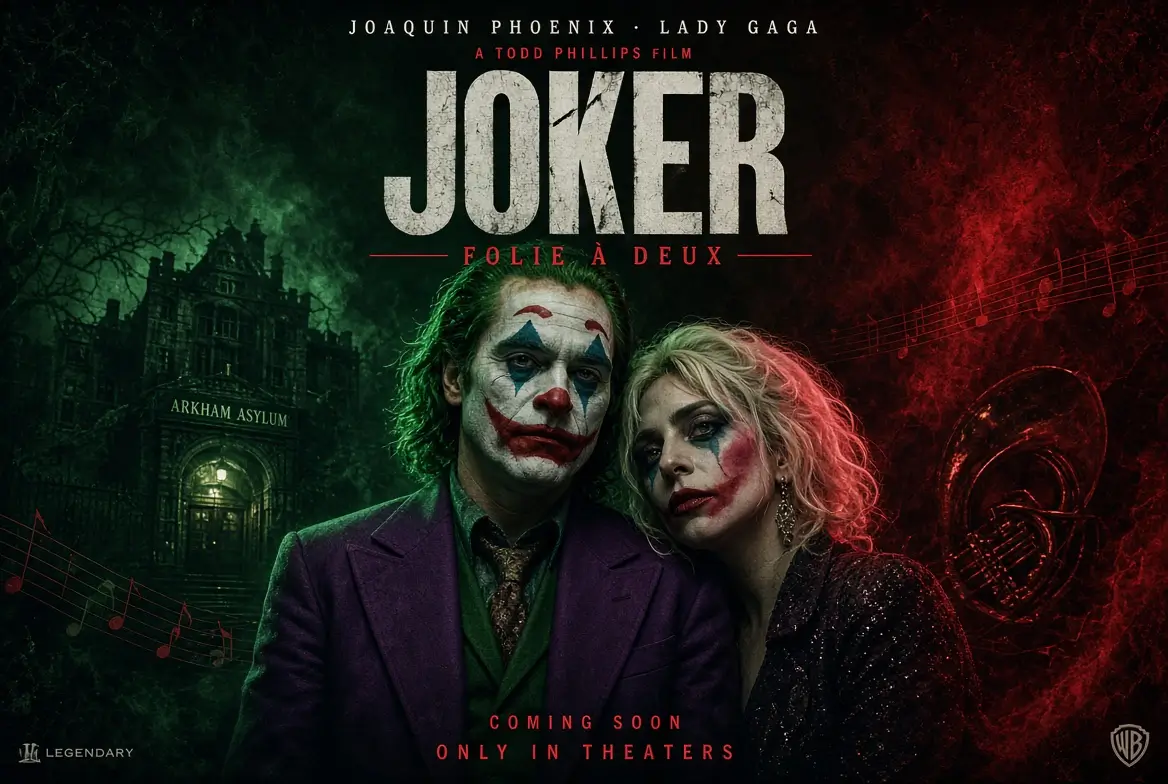
When Joker arrived in 2019, it arrived like a cultural rupture. Joaquin Phoenix’s gaunt, unsettling Arthur Fleck became an unexpected box-office phenomenon and awards contender, turning a DC origin story into a grim character study of isolation, media spectacle, and social fracture. The film’s success made a sequel almost inevitable, yet the follow-up that eventually emerged refused to deliver the same formula. Joker: Folie à Deux, released in 2024, shifted into the register of a musical psychological drama and courtroom story, pairing Phoenix again with Lady Gaga as Harleen “Lee” Quinzel. The result was one of the more polarizing major studio releases of its year.
Directed once more by Todd Phillips and co-written with Scott Silver, the film leans into the idea of shared delusion—the clinical meaning of its French subtitle—while testing how far an audience would follow Arthur Fleck into fantasy, romance, and self-rejection. What follows is an examination of the film’s central choices, its musical approach, the performances that define it, the story’s darker turns, and the complicated reception that greeted it.
The Story’s Focus on Imprisonment, Fantasy, and Shared Delusion
Joker: Folie à Deux picks up roughly two years after the events of the first film. Arthur Fleck sits in Arkham State Hospital, awaiting trial for the murders that turned him into a chaotic public symbol. Emaciated and heavily medicated, he appears drained of the manic energy that once propelled him through Gotham’s streets. The arrival of Lee Quinzel, a fellow patient who claims deep fascination with the televised version of his crimes, alters the emotional temperature of his confinement. Their connection forms quickly and intensely, blurring the boundary between genuine attachment and mutually reinforced fantasy.
The film treats their relationship as the core engine of the narrative. Music therapy sessions become the setting where attraction and identification take root. Lee presents herself as both admirer and co-conspirator in Arthur’s mythmaking, encouraging the Joker persona even as the legal system prepares to judge the man behind it. Phillips stages much of their bond through imagined musical sequences that externalize longing, power, and escape. These moments do not function as traditional show-stopping numbers so much as windows into a private world the couple builds together—and that the outside world continually threatens to dismantle.
The courtroom sequences that follow force the story into a different register. Harvey Dent appears as the ambitious prosecutor determined to hold Arthur accountable. Witnesses from the first film return to testify. The trial becomes both spectacle and reckoning, testing whether Arthur will lean into the Joker identity that parts of Gotham have romanticized or step away from it entirely. The film’s tension resides less in external action than in the question of which version of Arthur will survive the process.
Profile summary
| Category | Details |
|---|---|
| Full Title | Joker: Folie à Deux |
| Release Year | 2024 |
| Director | Todd Phillips |
| Lead Actors | Joaquin Phoenix (Arthur Fleck / Joker), Lady Gaga (Harleen “Lee” Quinzel) |
| Genre | Musical, Psychological Drama, Crime, Thriller |
| Runtime | Approximately 2 hours 18 minutes |
| Core Premise | Arthur Fleck awaits trial in Arkham and forms a intense bond with Lee Quinzel |
| Key Theme | Shared delusion (“folie à deux”), identity, rejection of public myth |
| Musical Style | Classic standards & show tunes, often performed live and restrained |
| Critical Reception | Mixed to negative (Rotten Tomatoes ~31%, Metacritic ~45–46) |
| Box Office | Approx. $207–208 million worldwide on a $190–200 million budget |
| Notable Outcome | Arthur renounces the Joker persona; the film ends with major consequences for him |
The Musical Approach and Its Deliberate Restraint
One of the most discussed decisions in Joker: Folie à Deux is its use of music. Phillips and his collaborators chose classic American standards and show tunes rather than original pop compositions. Songs such as “Get Happy,” “That’s Entertainment,” “Gonna Build a Mountain,” and “(They Long to Be) Close to You” appear throughout, sometimes in intimate exchanges and sometimes in larger fantasy sequences. Joaquin Phoenix and Lady Gaga performed many of these numbers live on set, prioritizing emotional immediacy over polished vocal perfection.
This approach creates a distinctive texture. The singing often feels fragile, conversational, or slightly off-kilter, matching characters who are not professional performers but people using melody to express what ordinary speech cannot contain. Gaga, whose pop career rests on technical power and theatrical flair, scales her voice down in many scenes, stripping away sheen in favor of something closer to the characters’ unstable inner lives. Phoenix, never a conventional singer, leans into rawness and vulnerability. The result can feel intimate or unfinished depending on the viewer’s expectations of a musical.
Some sequences open into more elaborate production numbers that evoke classic Hollywood musicals, complete with heightened lighting, choreography, and imagined stages. These moments contrast sharply with the grim realism of Arkham and the courtroom, underlining the gap between the couple’s private fantasy and the institutions that contain them. The music does not resolve conflict so much as illuminate the emotional weather inside it. For some viewers this restraint felt fresh and true to the characters; for others it withheld the catharsis or spectacle they associated with the genre.
Performances That Anchor an Unsteady World
Joaquin Phoenix returns to Arthur Fleck with the same physical commitment that defined the first film, yet the character has changed. The manic propulsion of 2019 has given way to a more depleted, watchful presence. Phoenix plays Arthur as a man who has tasted the power of the Joker mask and is now uncertain whether he can—or wants to—wear it again. The performance tracks small shifts in posture, voice, and eye contact as Arthur moves between medicated compliance, romantic intoxication, courtroom defiance, and eventual renunciation. It is a quieter turn in many stretches, reliant on the accumulation of detail rather than explosive set pieces.
Lady Gaga’s Lee Quinzel arrives with a different energy. She plays the character as both fragile and calculating, a woman who sees in Arthur a chance to rewrite her own story through shared mythology. Gaga brings sharp timing, physical specificity, and an ability to suggest layers of performance within the performance—Lee performing for Arthur, for the guards, and for herself. Their scenes together often hinge on the uneasy balance between genuine connection and mutual projection. Supporting turns from Brendan Gleeson as a rough Arkham guard, Catherine Keener as Arthur’s lawyer, and Harry Lawtey as Harvey Dent add institutional texture and opposing pressures that keep the central relationship from existing in isolation.
The chemistry between Phoenix and Gaga becomes the film’s primary dramatic resource. Whether their bond registers as tragic romance, dangerous co-dependency, or something more ambiguous depends heavily on how viewers respond to the musical sequences and the shifting power dynamics between the two characters. The performances commit fully to the film’s uncertain emotional terrain, even when the narrative around them draws mixed reactions.
Themes of Identity, Spectacle, and the Limits of Myth
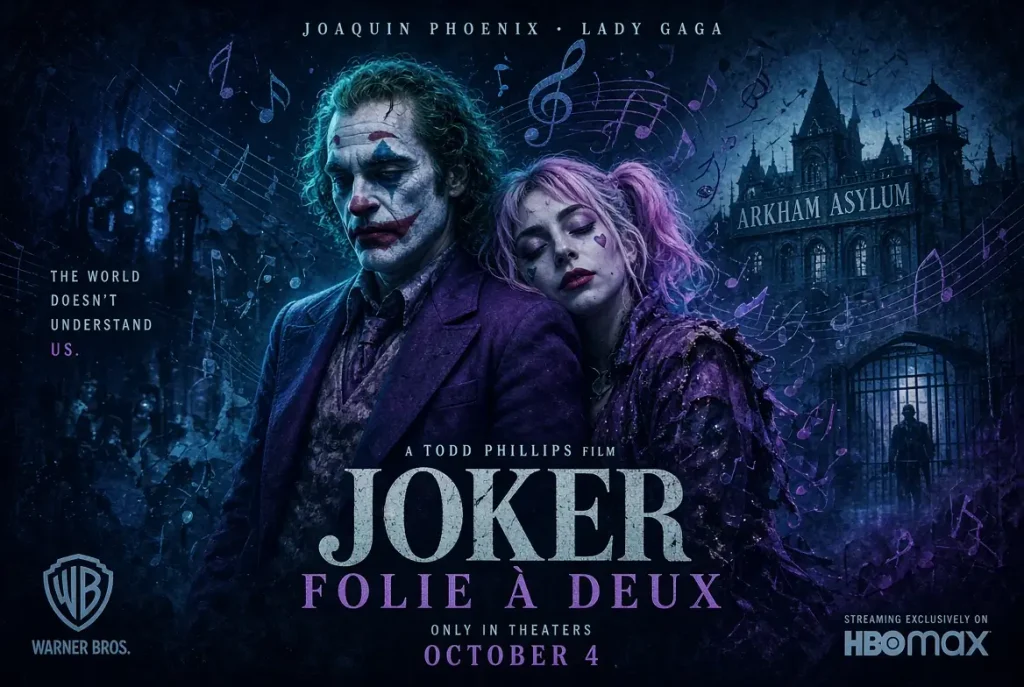
At its core, Joker: Folie à Deux continues the first film’s interest in how society creates and consumes symbols of chaos. Arthur Fleck never fully controls the meaning others assign to the Joker. Fans, media, and political actors project their own grievances and desires onto him. The sequel pushes this idea further by showing what happens when the man at the center of the myth begins to reject it. Arthur’s eventual decision to renounce the Joker persona in court is presented as both an act of self-reclamation and a devastating rupture with the person who loved the mask more than the man.
The relationship with Lee intensifies the theme. Their “folie à deux” is not simply romantic chemistry; it is a closed system of meaning that collapses when one partner steps outside it. Lee’s attachment appears contingent on Arthur continuing to embody the figure she has idealized. When he chooses a different self-definition, the shared fantasy dissolves. The film suggests that certain forms of connection depend on mutual participation in illusion, and that withdrawing from the illusion can feel like betrayal.
Spectacle itself remains under scrutiny. The televised trial, the crowds outside the courthouse, and the lingering public fascination with Arthur’s crimes all echo the first film’s critique of media amplification. Yet Folie à Deux is more skeptical about the transformative power of that attention. Where the earlier film ended on an ambiguous note of chaotic possibility, the sequel leans toward exhaustion and consequence. The final turns of the story reinforce the idea that myths outlive the people who temporarily inhabit them, sometimes at a lethal cost.
Reception, Expectations, and the Weight of a Predecessor
Joker: Folie à Deux arrived under the long shadow of its predecessor’s commercial and cultural success. The 2019 film had grossed over a billion dollars and earned major awards recognition. The sequel, made on a significantly higher budget, opened to mixed-to-negative reviews and underperformed at the box office, ultimately grossing roughly $207 million worldwide. Audience scores reflected disappointment from viewers who expected a more conventional escalation of the Joker mythos or a more traditional musical experience.
Critical response often praised the ambition of the musical concept and the commitment of the lead performances while questioning the film’s pacing, narrative momentum, and emotional payoff. Some found the restraint of the musical numbers and the focus on internal collapse more interesting than another round of urban chaos. Others experienced the same choices as frustrating or incomplete. The divide itself became part of the film’s public story: a high-profile sequel that refused to satisfy the expectations its own predecessor had created.
This reception raises broader questions about sequels to idiosyncratic original films. When a first movie succeeds by surprising audiences, the follow-up faces a structural problem. Delivering more of the same risks diminishing returns; changing course risks alienating the audience that made the original a phenomenon. Joker: Folie à Deux chose the riskier path. Whether that choice is ultimately viewed as principled or miscalculated continues to depend on individual tolerance for ambiguity, musical experimentation, and stories that withhold conventional catharsis.
Joker: Folie à Deux stands as a curious and contentious chapter in the recent history of comic-book cinema. It takes the bleak character study of the first film and redirects it into a musical exploration of love, delusion, and the rejection of a public persona. Joaquin Phoenix and Lady Gaga commit to the uneasy emotional logic of the material, while Todd Phillips stages the story as both intimate drama and institutional spectacle. The film’s commercial and critical struggles do not erase the clarity of its central choices. It remains a work that prioritizes a specific, often uncomfortable vision over broad satisfaction.
For some viewers the result feels like a necessary dismantling of the myth the first film helped inflate. For others it feels like a missed opportunity to expand that myth in more dynamic directions. Either way, the film leaves a distinct impression: a story about a man who briefly became a symbol, a woman who loved the symbol, and the cost of deciding that the performance was no longer sustainable. In its refusal to deliver easy answers or familiar thrills, Joker: Folie à Deux remains true to the uneasy spirit that made its predecessor notable, even as it charts a very different course.
Conclusion
Joker: Folie à Deux takes the bleak character study of its predecessor and redirects it into a more intimate, musically driven exploration of delusion, identity, and the cost of shared fantasy. Joaquin Phoenix and Lady Gaga commit fully to the uneasy emotional logic of Arthur and Lee’s bond, while the film stages their story against the cold machinery of Arkham and the courtroom. The musical sequences, often restrained and emotionally raw, become windows into a private world that cannot survive contact with reality.
The film’s commercial and critical struggles reflect the risk of its central choices. It refuses the familiar escalation many expected and instead follows a man who ultimately steps away from the myth that others projected onto him. Whether viewed as a necessary dismantling of that myth or a frustrating departure from the energy of the first film, Joker: Folie à Deux remains a distinctive and deliberately unresolved chapter. It leaves behind the image of a symbol that outlived the person who briefly wore it, and the quiet aftermath of choosing to stop performing.
Frequently Asked Questions
What does the title Joker: Folie à Deux mean?
“Folie à deux” is a French clinical term describing a shared psychosis or delusion between two people. The title points to the intense, mutually reinforcing fantasy between Arthur and Lee.
Is Joker: Folie à Deux a musical?
Yes. The film incorporates numerous musical sequences using classic standards and show tunes, performed largely live by the actors, though the style is often restrained rather than traditionally theatrical.
Who plays Harley Quinn in the film?
Lady Gaga portrays Harleen “Lee” Quinzel, a version of the character who forms a close and volatile bond with Arthur Fleck inside Arkham.
How does the story continue from the first Joker?
The film begins roughly two years later, with Arthur institutionalized at Arkham State Hospital and awaiting trial for the murders committed in the previous film.
What is the central relationship in the movie?
The emotional core is the connection between Arthur Fleck and Lee Quinzel, which blends romance, shared fantasy, and mutual projection.
How was the film received by critics and audiences?
Reception was mixed to negative. Review aggregation scores landed in the low range, and the film underperformed commercially relative to its budget and the success of the first movie.
Does the film feature returning characters?
Yes. Several figures from the first film reappear, including Sophie Dumond, and new characters such as Harvey Dent play significant roles in the trial sequences.
What happens to Arthur’s Joker persona in the story?
A major turn involves Arthur publicly distancing himself from the Joker identity during the trial, with significant consequences for his relationship with Lee and his own fate.
Who directed Joker: Folie à Deux?
Todd Phillips returned to direct, having also directed and co-written the 2019 film.
Is the film connected to the larger DC cinematic universe?
Like the first Joker, it exists as a standalone story inspired by DC characters rather than a direct continuation of other DC film continuity.
Read More:
